Personas & Storyboarding
Role: UX Researcher · Course: CSCI 1300, Brown University
Partner: Kate Atschinow
Context
In this project for CSCI 1300: User Interfaces and User Experiences, taught by Jeff Huang, we were asked to choose one interface we have interacted with and analyze it using concepts of mental models and personas. My partner Kate Atschinow and I chose to analyze the self checkout machine at CVS.
Interface Description
The self checkout machine is an alternative for customers to purchase items as opposed to going up to a traditional cashier. It helps to shorten checkout lanes and reduce wait times.
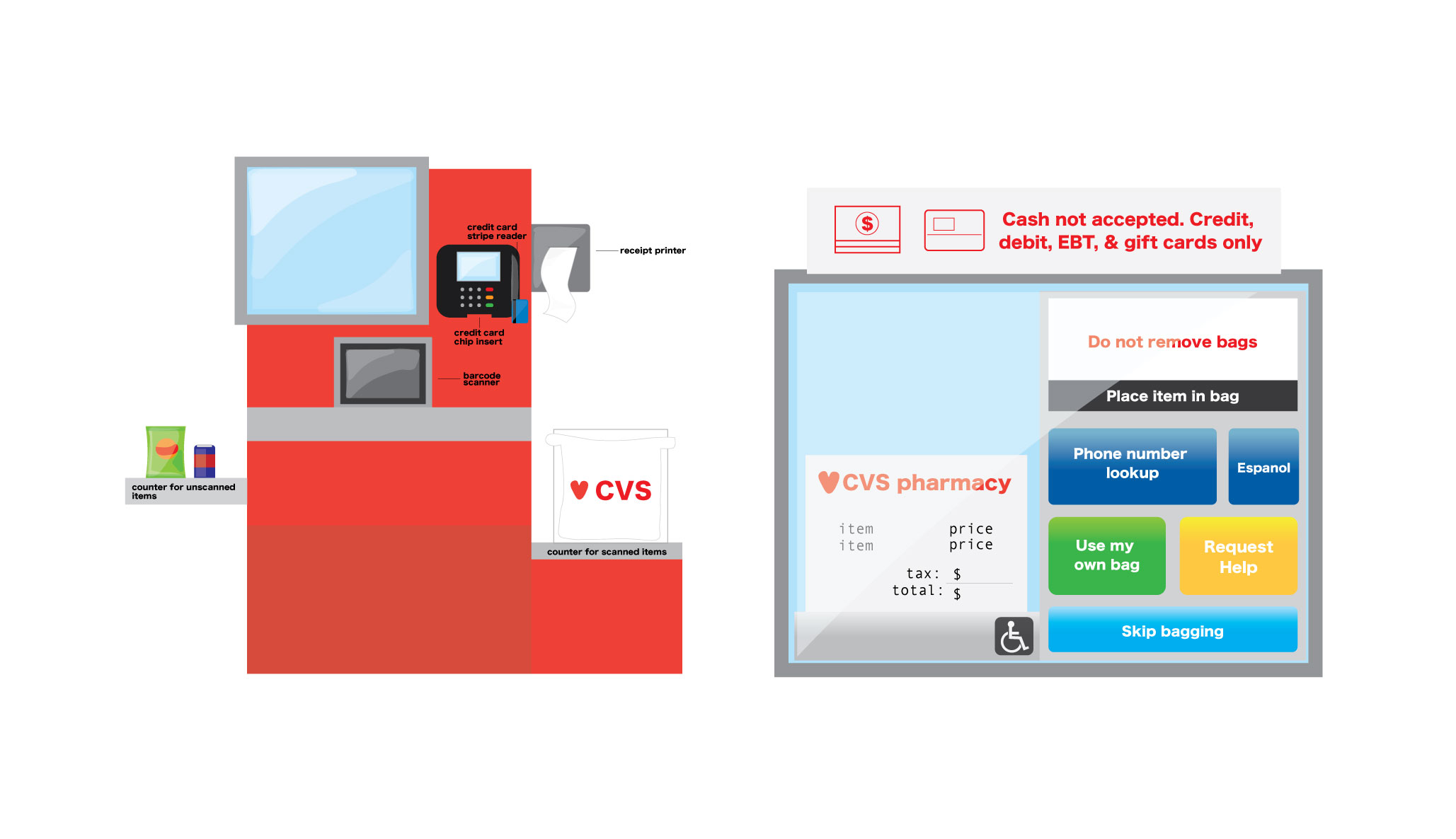
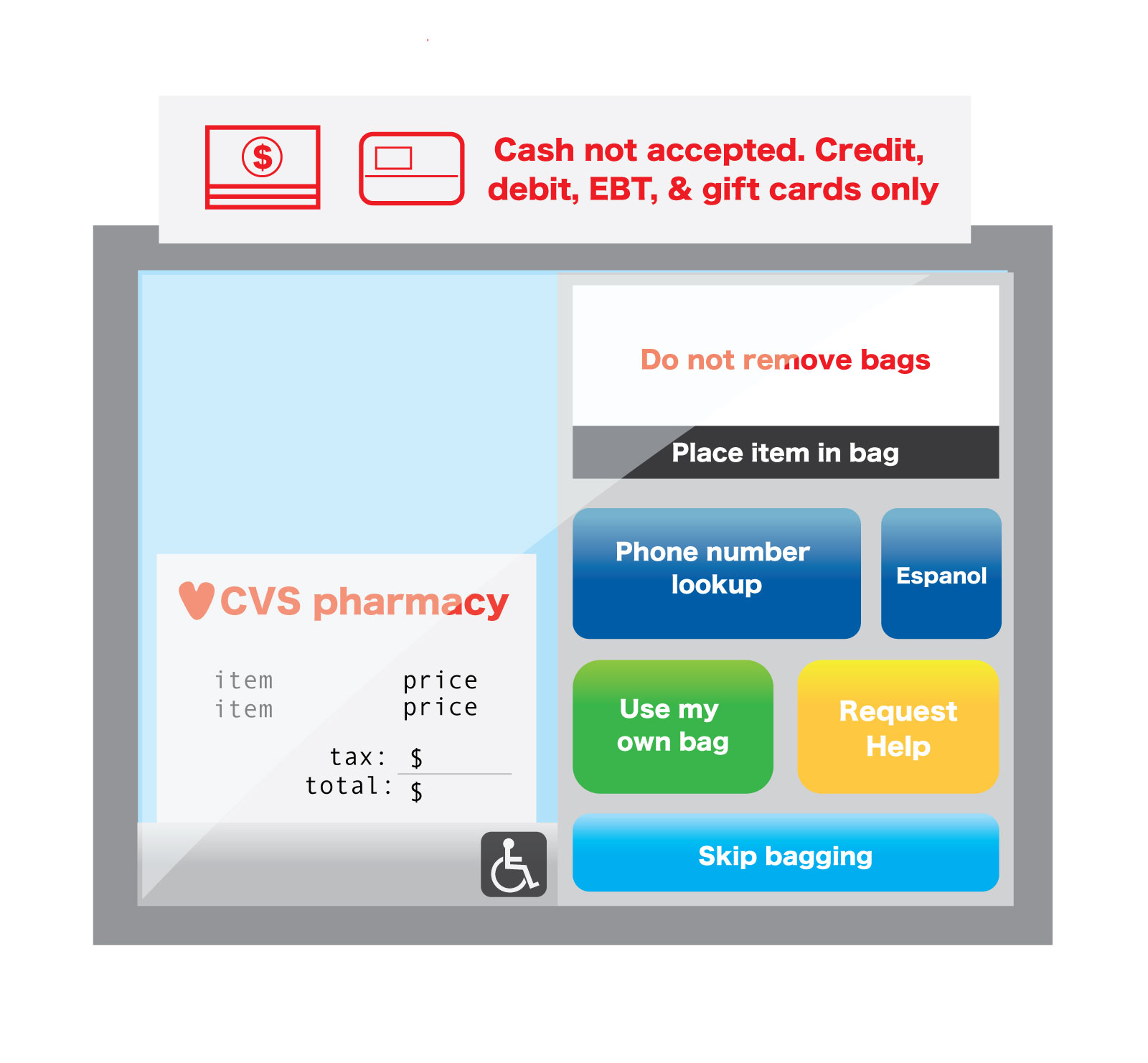
The self checkout machine contains four main components: the touchscreen display, item scanner, credit card reader, and bagging area. Customers scan each item barcode, place the item in the bag — which is verified by weight against previously stored information — press the appropriate buttons on the touchscreen display, and then make their payment via their preferred method.
Behavioral Observations
Most people we observed using the self checkout machine were college students, mostly because CVS is located right by Brown University. This means our sample primarily represented Brown University students and some Providence residents, and is not representative of broader demographics who might struggle more with the technology.
- A customer required staff assistance when the machine could not process an item.
- Customers often brought friends who assisted with button selection.
- Several customers clicked the “Skip Bagging” option, especially when their items were small, and did not place their items on the scale.
User Interviews
We interviewed two CVS customers about their experience with the self checkout machine.
Do you prefer self checkout or going to the cashier?
What are some reasons you prefer one over the other?
How likely are you to use the self checkout machine as opposed to going to the cashier?
What do you think can be improved with the user interface of the self checkout machine?
Are there any parts of the interface that you find confusing?
If you could change any features of the design, how would you?
How does this self checkout machine compare to self checkout machines you have used in other stores?
Mental Models
Mental Model #1 — Own Bag Error
The user selects “Use my own bag” and then places the item in their reusable bag after scanning. However, an error occurs and the machine does not let them scan their next item. The user cannot resolve the issue independently because they don't understand that “Skip Bagging” would bypass the weight detector error. They ultimately press “Request Help” while stressed.
Mental Model #2 — Skip Bagging Discovery
The user scans the item and places it in the plastic bag. The weight detector does not detect that an item has been placed there, and the user is not able to scan the next item. This user notices the “Skip Bagging” option and correctly infers it bypasses weight detection, successfully resolving the problem with minimal confusion.
Personas
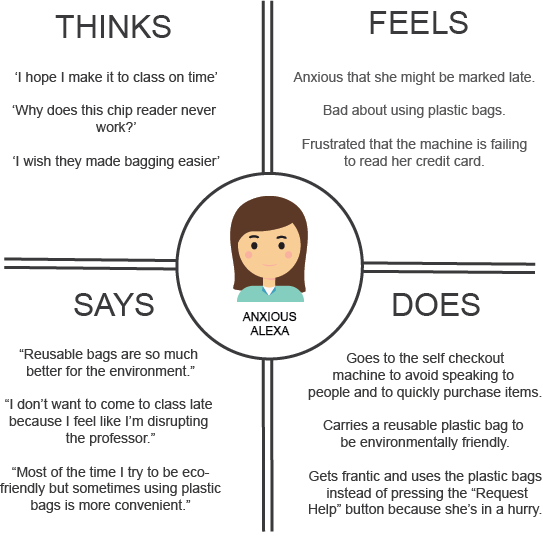
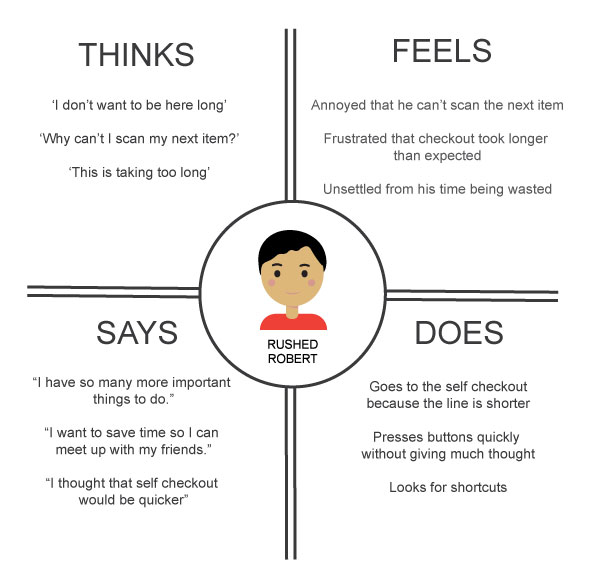
Rushed Robert is a student at Brown University who likes to use his time efficiently. He always looks for a way to do things as quickly as possible so he can keep up with his busy lifestyle. He juggles engineering coursework, soccer, and socializing, and chooses self-checkout for shorter lines, using plastic bags for convenience. His problem-solving skills help him identify machine malfunctions quickly.
Storyboard
.jpg)
Conclusion
Throughout this process of conducting behavioral observations and user interviews, we were able to gauge customers' general feelings about self-checkout. Most customers preferred self-checkout over traditional cashiers. Key issues centered on weight detection failures when scanned items fell outside normal ranges. Constructing mental models and personas helped us understand how different users react to and resolve these problems, and revealed the gap between users who discover the “Skip Bagging” workaround independently versus those who need staff assistance.